



Last Sunday, Sabastian Sawe ran the London Marathon in 1 hour, 59 minutes and 30 seconds. He became the first person to break two hours in an official race, a barrier many people said wasn’t humanly possible.
His backstory is remarkable.
Sawe grew up in a village in Kenya’s Rift Valley without electricity, raised mostly by his grandmother. He only ran 5,000 metres for the first time in 2019 - by accident, because he arrived late to an athletics meet and it was the only race left. He was injured in January this year and only started focused preparation for London in February.
But the thing that interests me most about Sawe isn’t how he races. It’s how he trains.
His coach, Claudio Berardelli, described it last week: nine to ten days of hard training, then a break. Workouts combined with recovery, adjusted depending on how Sawe’s body responds.
On hard days he pushes hard. On recovery days he actually recovers.
So when race day comes, he has everything available.
Your brain is a battery
Obviously we’re not running marathons. But the contrast is pretty obvious.
I’m guessing you start the average week with your calendar almost full. With no margin for anything unexpected. Certainly no time to reflect on where to focus your energy, let alone recover.
Because there’s nothing left, the thing that gets sacrificed is always the same: the thinking, the strategy, the stuff that never feels urgent but ends up mattering most.
It's not a willpower problem, and Samuel Marcora, a sports scientist, showed why.
He took two groups of people, of a similar age and same fitness level. One group watched a documentary for 90 minutes. The other spent 90 minutes doing a cognitively demanding task.
Then both groups did the same cycling endurance test. The mentally tired group gave up 15% earlier.
Now consider the typical working day for you and your team. Emails from the moment you wake up, context-switching all morning, back-to-back meetings - by mid-afternoon your brain is done. And you’ve probably still got a few hours of work to go.
We’ve only got about four to five hours a day of our best thinking, so why aren’t we pickier about what gets them?
Focus, not volume
Back to running for a moment.
When Roger Bannister broke the four-minute mile in 1954, he was training a fraction of the volume of his main rival - John Landy was running roughly five times more distance per week.
But Bannister - who was also a medical student and couldn’t train full-time - had figured out that the bottleneck to him performing at his best wasn’t endurance. It was his body’s ability to process oxygen and lactic acid at exactly the pace needed for four minutes. So all of his training was built around that one thing.
As you know, he broke the record first.
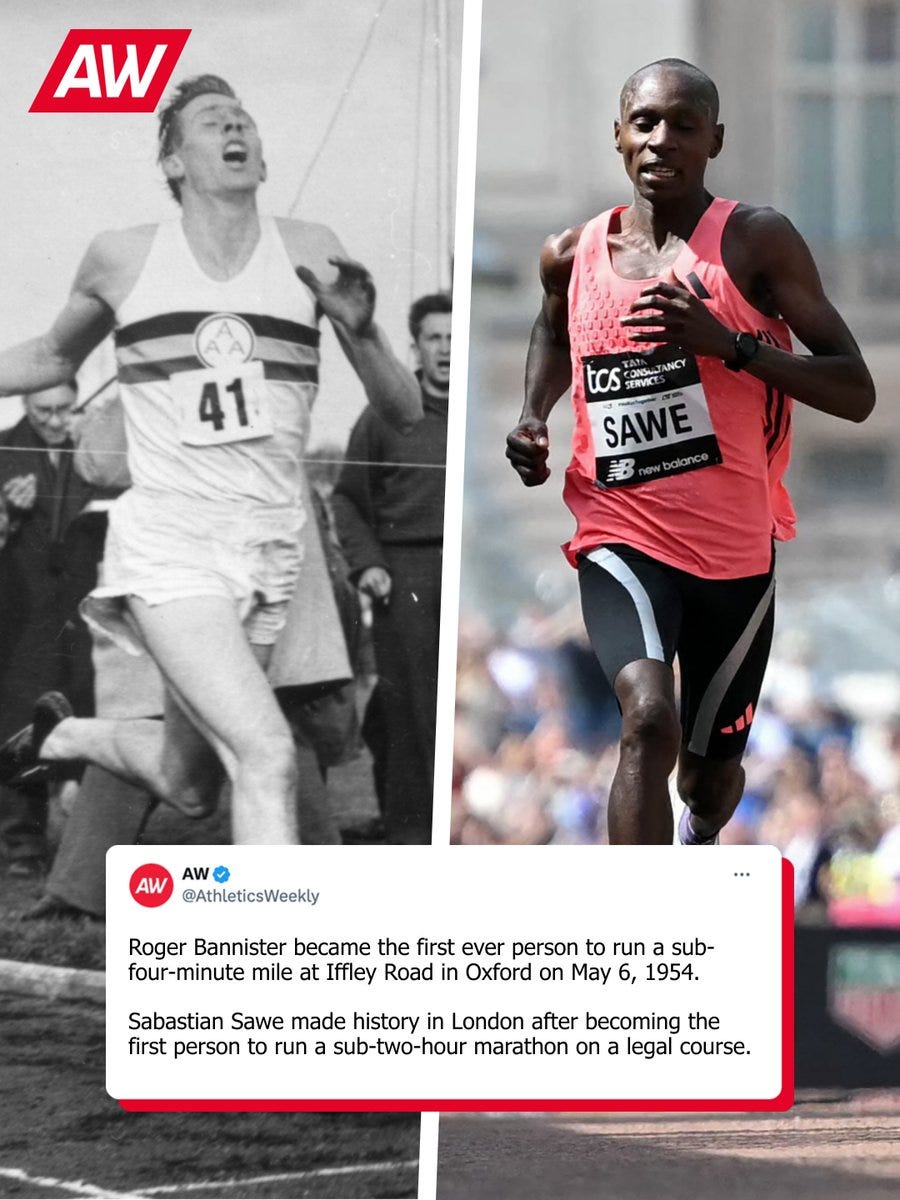
David Epstein and Cal Newport were chewing over this exact idea on Newport’s podcast this week. Epstein’s new book Inside the Box is full of examples of the benefits of constraints.
He tells the story of a company that makes custom gearboxes - every one unique and built to order. They were taking a year to deliver each one and when they looked at why, they found, on average, people were switching between tasks more than 50 times a day.
To fix the problem, they introduced one rule, one constraint: you can’t start a new design until you’ve finished the current one.
Within months, three times as many designs were going out the door. Delivery time dropped from a year to two months.
Again it’s easy to see a parallel here with how many teams are operating right now - and in this case, it’s a problem made worse by the ease with which AI can help you write a report, generate code, or create marketing campaigns.
Just because you can, doesn’t mean you should.
Race days and training days
Sabastian Sawe doesn’t run fewer miles than anyone else (200km a week seems pretty hefty!), but he and Berardelli are deliberate about which days are for pushing and which are for recovering.
They designed constraints.
I’ve been writing for the past few weeks about how companies should think about AI. But none of it matters if nobody has the headspace to act on any of it. Every leader I know agrees they should be experimenting more. Almost none of them have a single unprotected hour in their week to do it.
In this case, the biggest bottleneck isn’t technology, it’s their time.
Very unlikely you're going to break a world record this week, but you might need an hour to think clearly about something important. Your calendar won't give you that by default. You'll have to design the constraint yourself.
Thanks for reading.
Ollie
Ollie on Work is a weekly newsletter about what I’m learning from building with AI, advising leadership teams, and trying to bridge the gap between what technology can do and how businesses actually work. If someone forwarded this to you, you can subscribe here: