


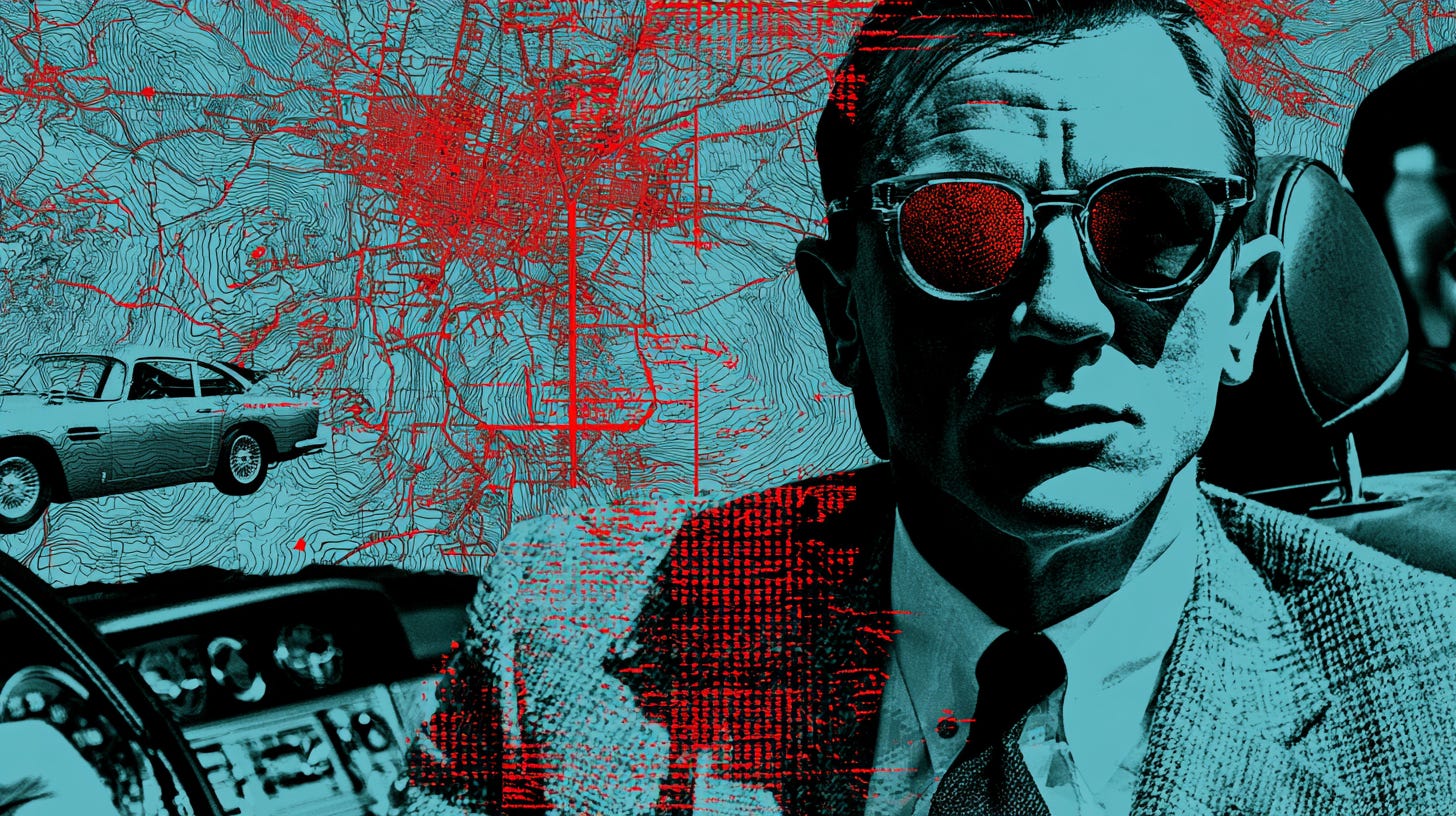
Around 2007, not long after he’d sold his first company, Uber’s co-founder Garrett Camp was watching Casino Royale when something caught his eye. Bond is tracking someone, and the chase is playing out on a phone screen - a dot moving across a map, updating in real time, closing in.
That image became the Uber map.
Of course, the map alone wasn’t the secret to Uber’s eventual success. It didn’t put more cars on the road, and it didn’t get a driver to you a second faster. Uber’s real problem - too few drivers, spread too thin across a city - would take years and a great deal of money to solve. But the map was the thing that got many of us hooked, because it went after something else entirely - not just waiting, but the frustration of not knowing how long we’ll wait.
Rory Sutherland calls this a psychological moonshot.
The map changed almost nothing about the wait itself, but it transformed how it felt - in your head, the equivalent of putting ten times as many cabs on the road.
Sold on speed
Now look at how we talk about AI.
Almost every tool is sold on speed - write the email faster, run the research faster, clear the inbox faster. But speed was never really the problem.
Last week, the economist Tyler Cowen - one of the calmer voices on AI - gave a keynote at the Sana summit in New York. The smart use of AI, he said, isn’t to read your WhatsApp messages faster. It’s to have an agent manage them for you, and tell you every couple of days when there’s something you actually care about.
The real cost of WhatsApp isn’t the minutes you spend reading it - it’s that the only way to know whether you need to look is to actually look.
And it isn’t only WhatsApp.
Maybe for you it’s refreshing a post to see if anyone’s commented, or a dashboard you check for tiny movements that won’t mean anything for a week, or the pull to be on Slack the second a message arrives in case it’s the one that matters. Whatever the screen, it’s the same low-level hum - is there anything new I need to see?
More to supervise
So it isn’t a new problem - but it’s one AI makes worse.
Earlier this year, BCG researchers writing in Harvard Business Review surveyed close to 1,500 people who use AI at work. The ones using it to take routine tasks off their plate reported 15% lower burnout than people using no AI at all. But the ones using it for what you might call ‘oversight’ - generating output, then reviewing it and deciding what to do with it - reported the opposite. More fatigue, more overload, and a 39% higher intention to quit. They called it “AI Brain Fry”.
So what’s really going on there?
What separated the two groups wasn’t how much AI they used, or which model, or how well they’d been trained. It was whether the AI was taking work off their plate, or handing them more to supervise.
Microsoft reckons the average employee is now interrupted every two minutes during core working hours - 275 times a day. But that only counts what comes at you. The other drain runs in the opposite direction - the watching and wondering, the mental tax you spend staying across everything, even when nothing’s really happening.
Which is why Cowen’s idea resonates.
An agent that watches for you - rather than you watching it - is the Uber map’s trick taken one step further. The map could only soothe the uncertainty, the agent actually removes it. You get both things at once - focus, and the reassurance that nothing’s slipping.
So forget how many minutes a tool saves you. The question worth asking - the one the Uber map answered - is whether it goes after the thing that's actually wearing you down.
It won't give you more hours. But does it let you stop watching?
Thanks for reading.
Ollie
Ollie on Work is a weekly newsletter about what I’m learning from building with AI, advising leadership teams, and trying to bridge the gap between what technology can do and how businesses actually work. If someone forwarded this to you, you can subscribe here: