


Today’s newsletter is all about Deep Research. As most readers use ChatGPT, I’ll reference this throughout - but you can replicate the processes and prompts in Claude, Copilot, Gemini and Perplexity too.
I just scrolled through my ChatGPT history - past the client work and strategy questions, it’s a mess.
How to isolate my son’s voice from a noisy video clip. Whether athlete’s foot cream is safe for an eight-year-old. A detailed plan for connecting a Technics turntable through Sonos with a Cambridge pre-amp.
Your chat history probably looks similar. Random life stuff you’d have previously Googled.
But AI can do way more than answer questions.
Most people know AI is good for quick answers. What they haven’t discovered yet is that it can do research that used to take hours - and do it better than you could manually.
Not just faster. Actually better.
Finding patterns you’d miss. Synthesising insights from dozens of sources. Connecting dots that aren’t obvious when you’re reading one article at a time.
Beyond a quick search
My family and I are going to Mexico’s Caribbean coast over Christmas.
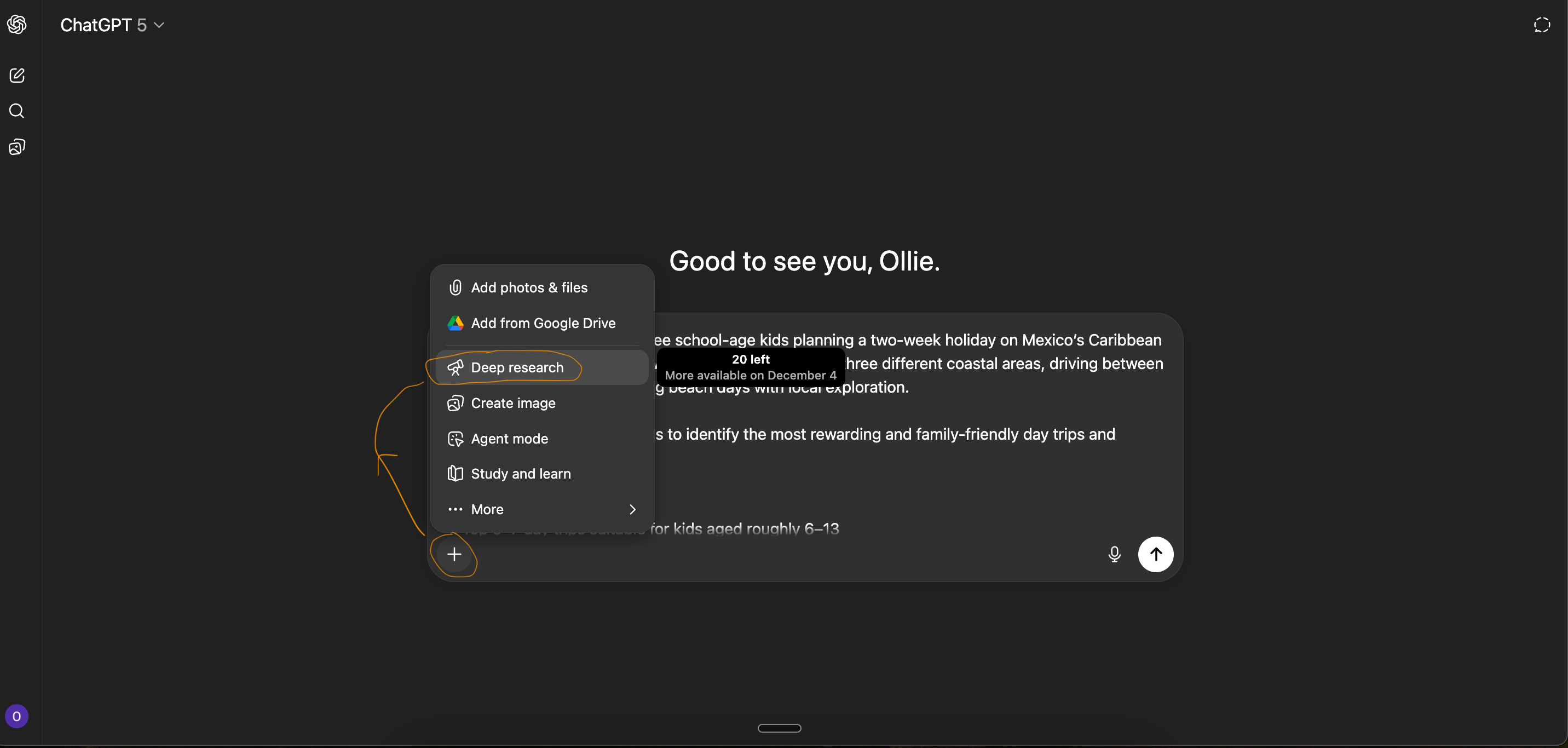
Instead of Googling “best day trips Riviera Maya,” I gave ChatGPT’s Deep Research this:
We’re a family of five with three school-age kids planning a two-week holiday on Mexico’s Caribbean coast over Christmas and New Year. We’ll be staying in three different coastal areas, driving between them, and want to mix relaxing beach days with local exploration.

Do a Deep Research synthesis to identify the most rewarding and family-friendly day trips and activities across this region.

Focus on:
1. Top 5–7 day trips suitable for kids aged roughly 6–13
2. Best times of day to visit (crowds, weather, energy levels)
3. Travel logistics: driving distances, parking, food options, facilities
4. Seasonal insights for late December to early January

Prioritise:
- Real 2024–2025 visitor experiences over generic travel sites
- Recent, verifiable sources (TripAdvisor, Reddit, Google Maps reviews)
- Balanced days that combine activity and rest

Format: For each day trip:
- Title + brief description (max 100 words)
- Ideal visit timing and duration
- Family-specific notes (ease, facilities, food, safety)
- Seasonal considerations

Conclude with a summary table comparing each option.
30 minutes later: an 18-page synthesis covering eight destinations.
This includes advice on specific timing, like “arrive at Chichén Itzá by 8 AM to beat the ~5,700 daily visitors.”
Seasonal notes like “late December means cooler cenote water - still swimmable but bring towels for after.”
Every claim is cited, each piece of advice is linked back to its source - TripAdvisor, Reddit, local blogs etc. That lets me verify anything that matters and pick up on hallucinations.
Could I have pieced this together manually? Yes, if I spent a full day reading reviews and forums.
But Deep Research did it for me in half an hour - and I can interrogate it further if I want briefer conclusions or clarification.
As ever, for important research, run it through multiple tools and cross-reference (see last week’s newsletter for more on this).
Why deep research takes your work up a level
So that’s really useful for planning a holiday, but how do you use this for your work?
Well, let’s be honest, most work research is surface-level. You Google around, read a few articles, piece together something reasonable. You know what everyone else knows.
If done right, AI research creates differentiation.
When you structure it properly, AI doesn’t just find information faster - it finds insights you wouldn’t discover manually. Patterns across dozens of sources. Non-obvious connections.
Three examples
1. Competitive intelligence
Research: [Competitor]’s go-to-market strategy over the past 18 months

Focus on:
- How they’re positioning against us specifically
- Changes in messaging, pricing, target market
- Which customer segments they’re winning vs losing
- Recent hires indicating strategic shifts

Prioritise:
- Customer review sites and buying decision discussions
- Job postings that reveal priorities
- Patterns in case studies and customer logos

Format: Strategic overview, then tactical details. Flag anything suggesting they’re moving into our territory.
2. Strategic planning
Research: Companies that successfully pivoted from SMB to enterprise in B2B SaaS

Focus on:
- What changes were required (product, team, sales, pricing)
- How long transitions took
- Early indicators it was working/not working
- Common mistakes that slowed transitions

Prioritise:
- First-hand accounts from founders/operators
- Companies of similar size/stage to ours
- Pivots in the past 5 years

Format: Phase-by-phase breakdown with milestones and warning signs.
3. Content strategy
Research: Underexplored angles in [your market/topic area]

Focus on:
- Topics that should be getting attention but aren’t
- Angles that differ from standard approaches
- Questions your audience asks that competitors aren’t answering

Prioritise:
- Community discussions, forums, subreddits
- Comments on competitor content revealing unmet needs
- Adjacent industries dealing with similar issues

Format: 10 underexplored angles with explanation of why it matters and why competitors miss it.
When to use this
Deep Research takes at least 10 minutes. Longer if you go super deep into a topic. Don’t use it for everything.
Use it when:
Research informs a significant decision or needs synthesis across multiple sources
Others will see this work (clients, leadership, your team)
Understanding patterns matters as much as facts
Don’t use it when:
You need a quick fact
The answer exists in one place
Speed matters more than depth
“What is design thinking?” doesn’t need Deep Research.
“How do companies actually implement design thinking in practice - what works and what’s just theory?” does.
The point
Being a world-class AI manager isn’t about knowing every tool.
It’s about understanding which capabilities create genuine competitive advantage - and using them when it matters.
AI research is one of those capabilities. Done properly, it doesn’t just save time. It produces insights you couldn’t get manually. Patterns you’d miss.
It can help you get your job done better and faster.
But if in the meantime, it helps you plan a better holiday, then why not start there.
Good luck experimenting.
Ollie
Next week: How I used AI Research as part of an end-to-end AI-supported workflow to build Monetization Works - from initial market research through to product framework.