


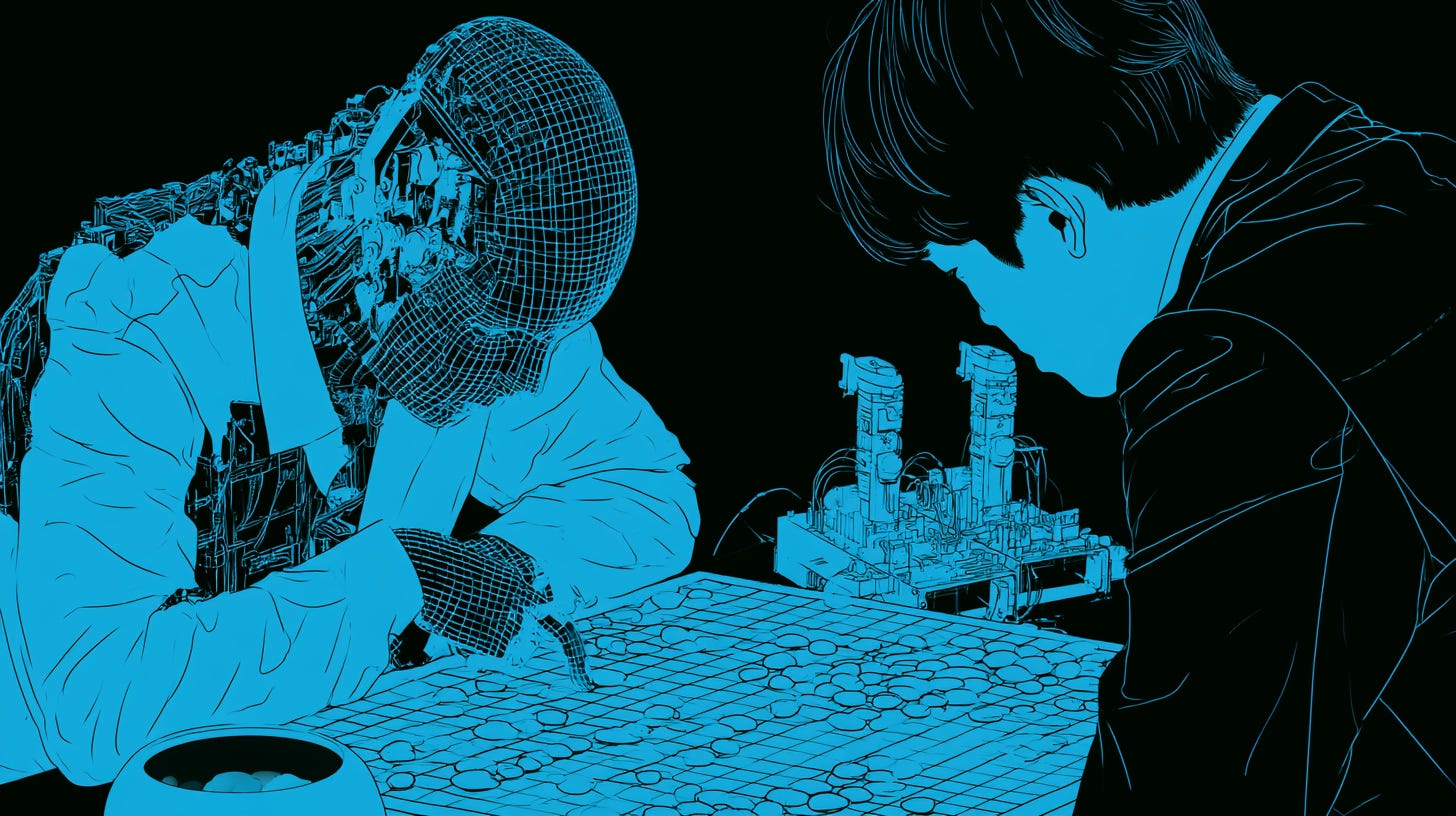
In March 2016, the South Korean Go grandmaster Lee Sedol sat down in Seoul to play game four of his five-game match against AlphaGo, built by Google’s DeepMind. Go is an ancient board game, far harder for computers than chess. He was down 0-3.
For three days, DeepMind’s AI had been doing things no Go master had seen before.
Game two had given the world Move 37, a black stone placed in a mostly empty zone that the top Western commentator put on his demonstration board, then removed because surely it was a mistake. Wrong - it turned out to be decisive, and Lee resigned. He resigned the next game too.
In game four, with nothing left to lose, he played Move 78. A move so unorthodox the system that had been crushing him for three days began to err. AlphaGo flailed, started making nonsensical moves, and ultimately resigned.
So what broke AlphaGo?
For one game, Lee found a line it couldn’t read. It’s the move that made headlines - the night a human beat the machine - and close to the last time that happened.
But the move worth dwelling on is AlphaGo's.
DeepMind's system had been trained on a vast archive of human Go games. And yet Move 37 was a move almost no human would have played - the machine came up with it, not the man.
So much for the idea that invention is uniquely human.
Except that the AI could do all this only because Go is a closed world - fixed rules and only one way to win - where you can play yourself a billion times and end up better than everyone alive.
That maps neatly onto the repetitive, rule-bound parts of a lot of jobs. But it’s not true of everything we do - and the history of technology doesn’t suggest the future is anywhere near as predictable as some would have you believe.
More work, not less
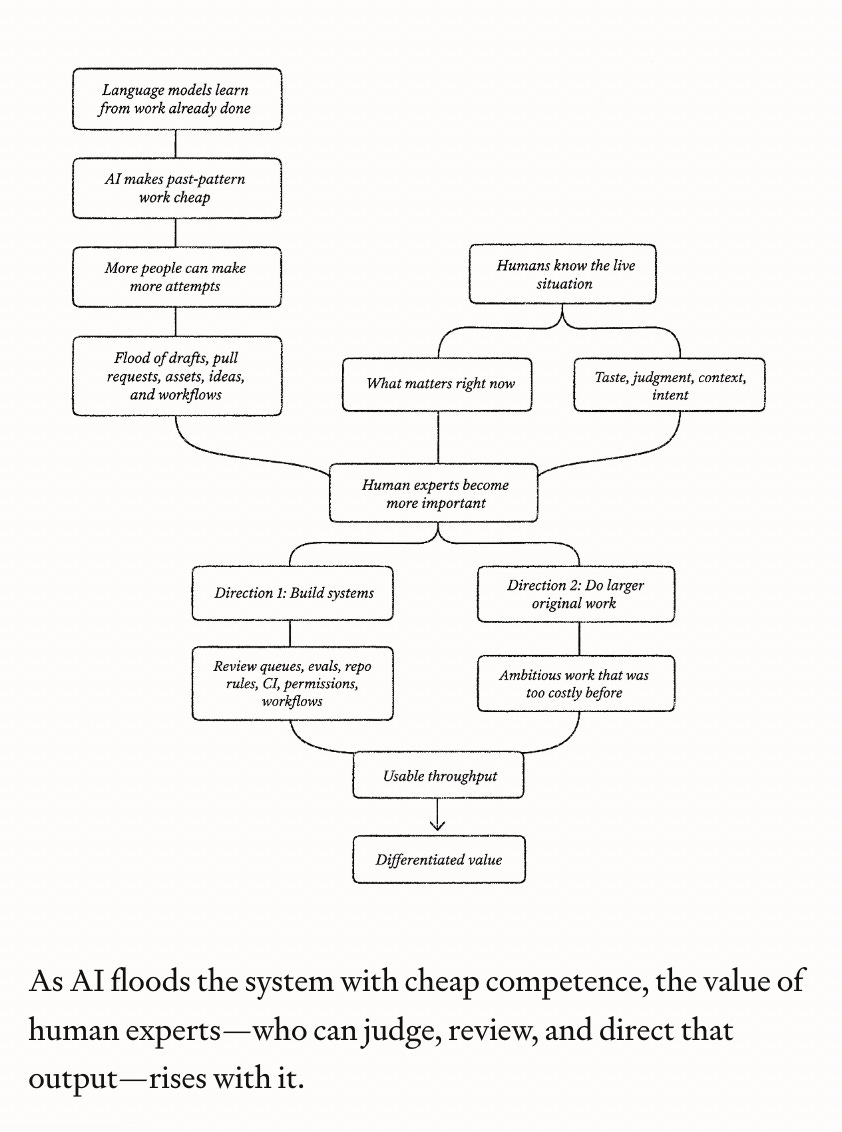
Dan Shipper runs a small writing and tech company called Every, and published an essay last week called After Automation. His team has automated everything they can - Claude Code and OpenAI’s Codex across coding, writing, design, customer service.
You might guess from that setup that he’d be writing about how AI has thinned his team out, but it’s the opposite.
Despite all that automation, his team of thirty has more work to do than ever. Nobody’s been laid off - they’re still hiring writers, editors, engineers. The work has changed shape, but there’s way more of it.
When Shipper gets to the explanation, it sounds a lot like the Lee Sedol match.
AI gets very good very fast at the work that’s been written down. What took a senior engineer or a copywriter a day now arrives in seconds. What’s left for people is the other stuff - knowing which problem is worth solving, reading the situation in front of you, making the call when there’s no clean answer.
But across the whole economy - does any of this mean fewer jobs? Well, the early data cuts both ways
The youngest workers - 22 to 25 - in the jobs most exposed to AI, like software and customer service, have fallen about 16% behind comparable workers since 2024.
And yet, asked directly, more employers expect AI to grow entry-level hiring than to cut it.
And AI is only part of what’s going on. We’re still feeling the after-effects of Covid, with remote work in particular radically reshaping how younger people experience work. So it’s hard to say what’s driving what.
The work that isn’t a game
Ten years on, the Go match tells us a story the numbers currently can’t.
The work that goes first to the machine is the work that looks like Go - closed, scoreable, a right answer you can check. What’s left doesn’t.
And once it’s taken the Go-shaped parts, there’s more of the other, messier kind to do.
That messier kind is where Move 78 came from - the move Lee found by reading the board in front of him, not by grinding the same game a billion times.
There’s a line from the computer scientist Larry Tesler:
Intelligence is whatever machines haven’t done yet.
The moment a machine can do something, we stop calling it intelligence and call it software.
Move 37 was creative right up until AlphaGo played it. Then it was just Go.
Creativity is the edge that keeps moving - the part nobody’s defined yet. We innovate, we define the thing, the model learns it, and the creative work is already somewhere new.
Which is the reassuring part, oddly.
Every technology kills off some jobs and creates others, and - as Benedict Evans points out - you can never name the new ones in advance, because they don’t exist yet. In 1800 nobody could have told you their grandchild would make a living as a railway engineer.
On the evidence of the last two hundred years, the new work has always turned up - we just can’t see it coming.
That doesn’t make the transition painless - the long view is no comfort to the 22 year old inside that 16%. Both things are true at once.
The question worth sitting with is which parts of your job were never a game at all.
Thanks for reading.
Ollie
Ollie on Work is a weekly newsletter about what I’m learning from building with AI, advising leadership teams, and trying to bridge the gap between what technology can do and how businesses actually work. If someone forwarded this to you, you can subscribe here: