


I write Future Work/Life to help you build great teams and careers. If you find it interesting, please share it!
Imagine you're at a restaurant having dinner when you notice a man at the next table suddenly clutch his throat.
He's choking.
The room freezes.
Everyone's eyes dart around, waiting for someone else to step up.
In that moment, you have a choice. Wait for someone more qualified, or act.
In 1974, psychologists Darley and Latané coined the term ‘diffusion of responsibility’ after studying exactly this kind of situation. They discovered something troubling. The more people present during an emergency, the less likely anyone is to help. We assume someone else will take responsibility.
This same phenomenon plays out every day in our work lives.
When processes are broken, when communication fails, when opportunities are missed - we look around waiting for someone to fix it.
The senior leader.
The expert consultant.
The dedicated task force.
But here's the truth most of us don't want to hear. No one is coming to rescue your career, your team, or your company.
And that's actually fantastic news.
High agency is your competitive advantage
I started recording the new series of the podcast last week in conversation with Eric Jorgenson. We discussed how leverage works in modern careers - a central theme in his books about Naval Ravikant and Balaji Srinivasan (with Elon Musk next on his list).
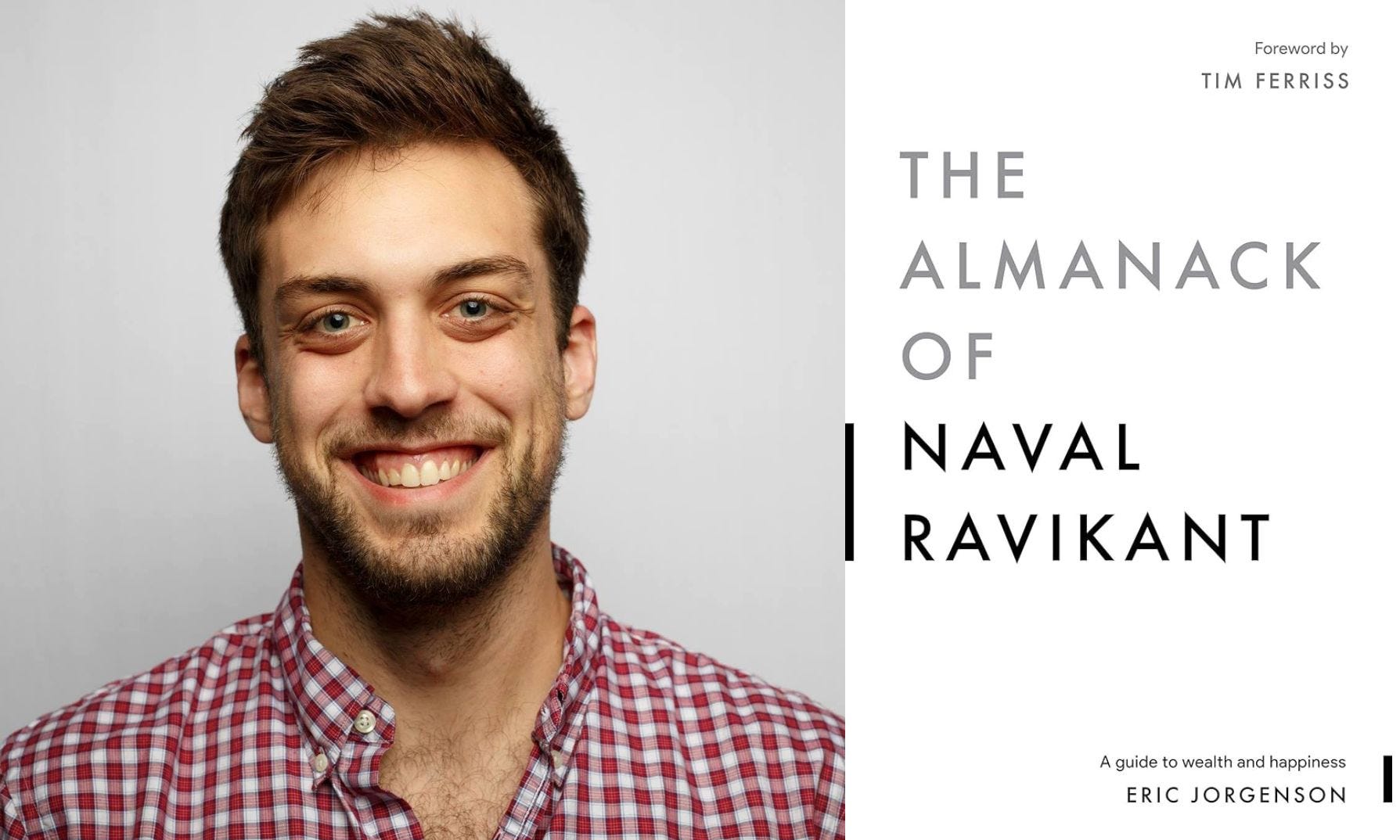
During our chat, Eric pointed me to George Mack's essay ‘High Agency’, which brilliantly captures what happens when people stop waiting and start acting.
High agency isn't just one skill - it's three distinct abilities rarely found together:
Clear thinking: Cutting through noise to identify the real problem
Bias to action: Executing rather than just theorising
Disagreeability: Pushing back when someone says "no"
Think about who you'd call if you were stuck in a foreign jail.
They have all three qualities.
Without clear thinking, they'd charge ahead with the first bad plan.
Without bias for action, ideas would stay theoretical.
Without disagreeability, they'd quit at the first roadblock.
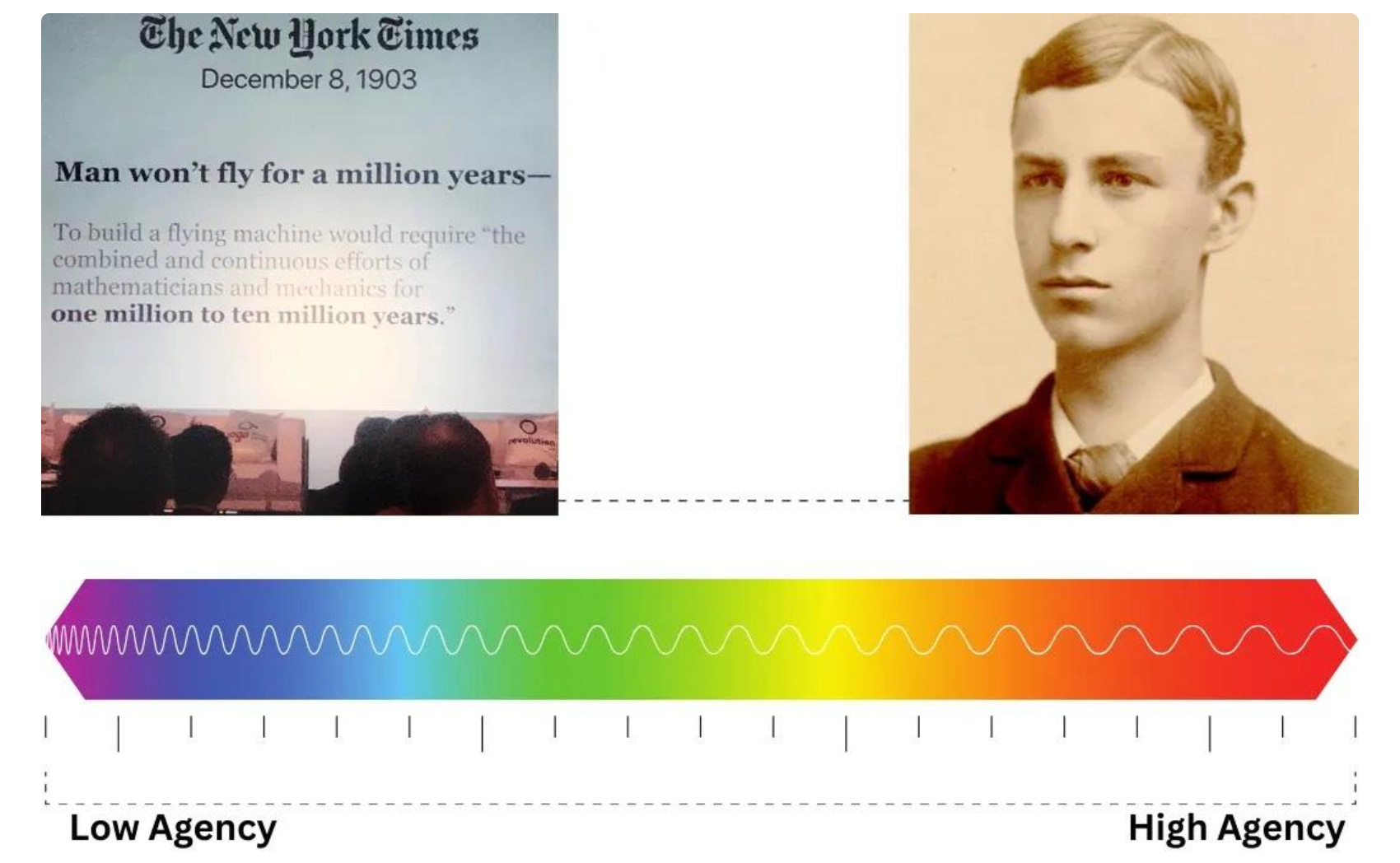
Wilbur Wright - of the famous Wright brothers - embodies this perfectly. In fact, as George Mack says:
"Wilbur Wright might be the highest agency human ever to live."
Wilbur's story is remarkable.
At 18, his face was smashed in by a hockey stick, leaving him bedridden for years. His dreams of attending Yale were destroyed.
Instead, Wilbur became obsessed with birds and flying.
When the New York Times declared "Man won't fly for a million years," Wilbur refused to accept it. He and his brother Orville built gliders, created their own wind tunnels, and even designed a custom aluminium engine when none existed that was light enough.
And high agency isn't limited to technological breakthroughs.
Consider Candy Lightner, who founded Mothers Against Drunk Driving (MADD) in 1980 after her 13-year-old daughter was killed by a repeat drunk-driving offender. Rather than just grieving, she channelled her pain into action, creating an organisation that transformed drunk driving laws across America.
Through clear thinking about the systemic problem, immediate action while others might have been paralysed by grief, and a refusal to accept the status quo, she helped reduce drunk driving deaths by over 50% through tougher laws and increased awareness.
These examples of extraordinary agency stand in stark contrast to how we tend to operate. Unlike Wilbur and Candy, most of us get caught in low agency traps:
Vague thinking: Never defining the problem clearly enough to solve
Rumination: Endless "what if" loops that prevent action
Overwhelm: Paralysis from seeing the scale of what needs to be done
These traps keep us stuck explaining why change is impossible rather than asking what we can influence right now.
Agency at scale: From individuals to organisations
This need for agency isn't just personal - it's organisational.
Bruce Daisley wrote an excellent piece this week exploring how, as AI makes intelligence more ubiquitous, human agency could become the critical competitive advantage.
In his essay, Bruce highlights a profound shift:
"Until now the most highly prized asset was human talent, the bigger the brains on your side the better your chances. The war for talent was real, corporations scrambled to hire the cleverest graduates."
A meta-analysis of over 130 research studies found that teams given more agency were significantly more creative than those under tight control. Netflix built their culture on this principle - they call it "freedom and responsibility," deliberately choosing autonomy over control to encourage speed and ownership
As Bruce puts it:
"This debate highlights a decision that organisations aren't yet contemplating: how are we going to liberate our teams to move faster when brainpower is no longer the bottleneck to success?"
He believes that most leaders aren't preparing for this future that could be just two or three years away.
Stop adding fuel. Reduce friction.
So how can you become more high agency?
Well, here's where most of us get it wrong. We think the path to higher agency is more motivation - more inspiration, better logic, stronger incentives. We assume that if we just push harder, things will move.
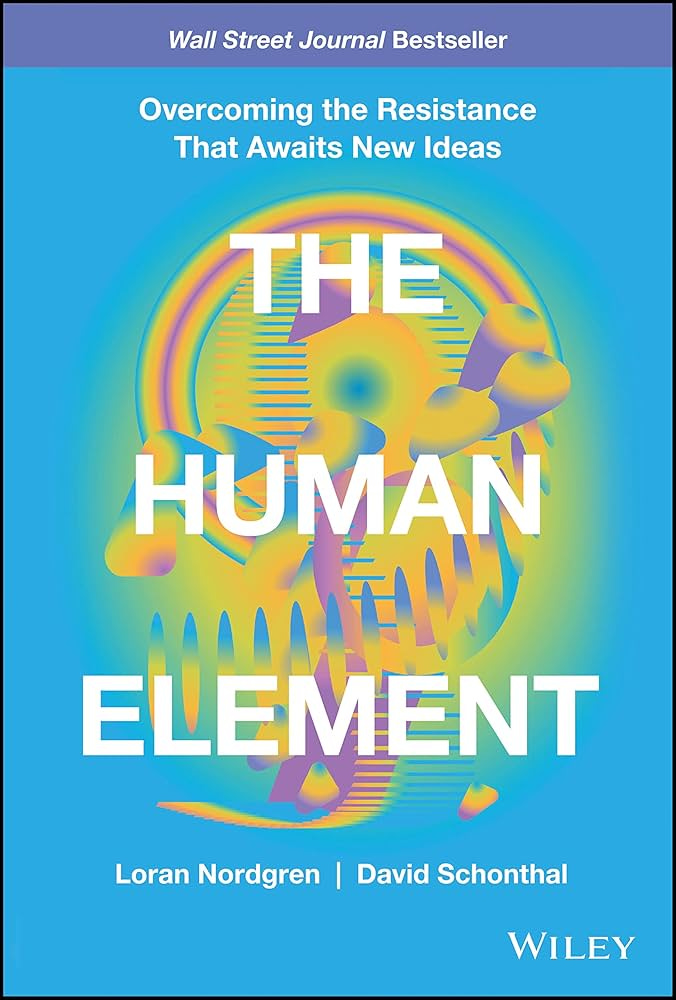
This is what David Schonthal and Loran Nordgren call the "fuel" mindset in their book The Human Element. It's logical. It's familiar. It's also usually wrong.
The bigger barrier to action isn't lack of motivation. It's the presence of friction. And here's the dangerous part - the harder you push without addressing what's in the way, the more resistance you create.
Four types of friction block action:
Inertia - People stick with what they know, even when it doesn't work.
Effort - Change feels harder than staying put.
Emotion - Fear or uncertainty about what might go wrong.
Reactance - Resistance to feeling pressured or controlled.
Each of these forms of resistance makes change harder.
Imagine a leadership team trying to get their organisation to adopt a new collaboration tool. They create comprehensive presentations. Run training sessions. Offer incentives for early adopters. Yet months later, adoption remains low.
Why? The fuel might be strong, but the friction is stronger:
Inertia: People have established workflows in the old system.
Effort: The tool requires learning new interfaces and migrating existing projects.
Emotion: Staff worry about looking incompetent during the transition.
Reactance: The mandate feels imposed from above with no input from users.
The turning point in these situations often comes when teams stop trying to convince people and start making it easier instead.
Start here: The 10% easier test
So here's your challenge: Pick one thing you've been stuck on - personally or with your team - and ask:
"What could make this 10% easier?"
Don't try to solve the whole problem. Just identify one specific friction and reduce it:
If inertia is the issue: Create a bridge to the new approach. If adopting a new tool, start by recreating one familiar template people already use.
If effort is blocking progress: Make the first step trivial. Instead of a complete report, ask for three bullet points in an email to begin with.
If emotion is the barrier: Lower the stakes. "Let's test this for 15 minutes on Friday" feels safer than "This is our new approach."
If reactance is the problem: Give genuine choices. "We need to transition by month-end - you choose which part to start with" works better than "Everyone must use this by Monday."
It's not always about better incentives or more convincing arguments. It's about identifying and removing the specific barriers that are blocking progress.
Remember: No one is coming to save you or your team.
But that's good news.
It means you don't have to wait for the perfect conditions, the right authority, or some magical alignment of resources.
And blindly taking action isn't the hard part. Making action easier is where the real work - and the real leverage - lies.
Have a great week,
Ollie