


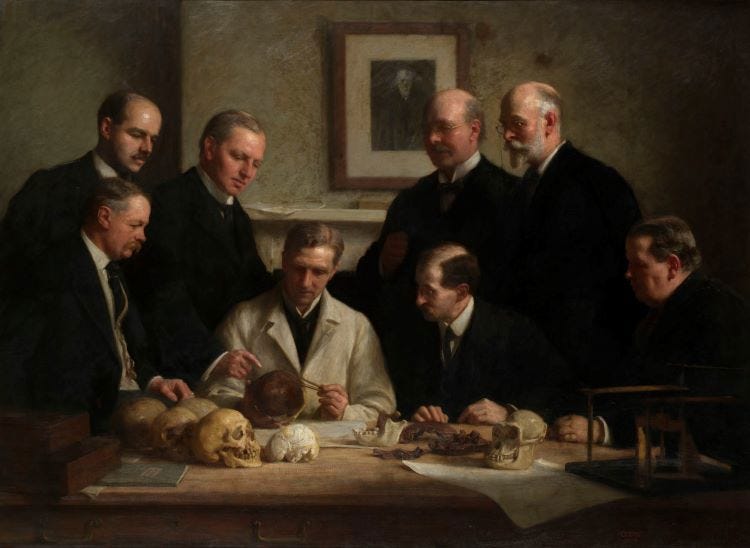
In 1912, a country solicitor named Charles Dawson stood up at the Geological Society of London and announced he’d found the missing link between ape and human, dug out of a gravel pit in Sussex.
It was everything Britain wanted to hear - the earliest Englishman, no less.
They gave it a Latin name, Eoanthropus dawsoni, Dawson’s dawn man, and Arthur Smith Woodward, the Keeper of Geology at the Natural History Museum, put his name to it. Britain had its ancestor, and it was thrilled.
Problem is, it was a fake.
A medieval human skull, an orangutan’s jaw, and a few teeth filed down by hand to look human, then stained brown to look old. This wasn’t a mix-up in the field - someone had built it on a workbench.
And yet it sat in the textbooks for forty-one years.
Because the fake looked so exactly like the answer everyone wanted, it sent real science down the wrong path.
Piltdown had a big brain and an ape’s jaw, which propped up the prevalent theory that the brain evolved first. So when a young anatomist called Raymond Dart described the real thing in 1925 - small-brained, but walking upright - the big-brained fake made it easy to dismiss him for years.
Nobody had checked it, and everyone downstream paid the price.
Polished but hollow
By now you’ll have heard the word workslop. You’ll have been sent plenty, too, no doubt.
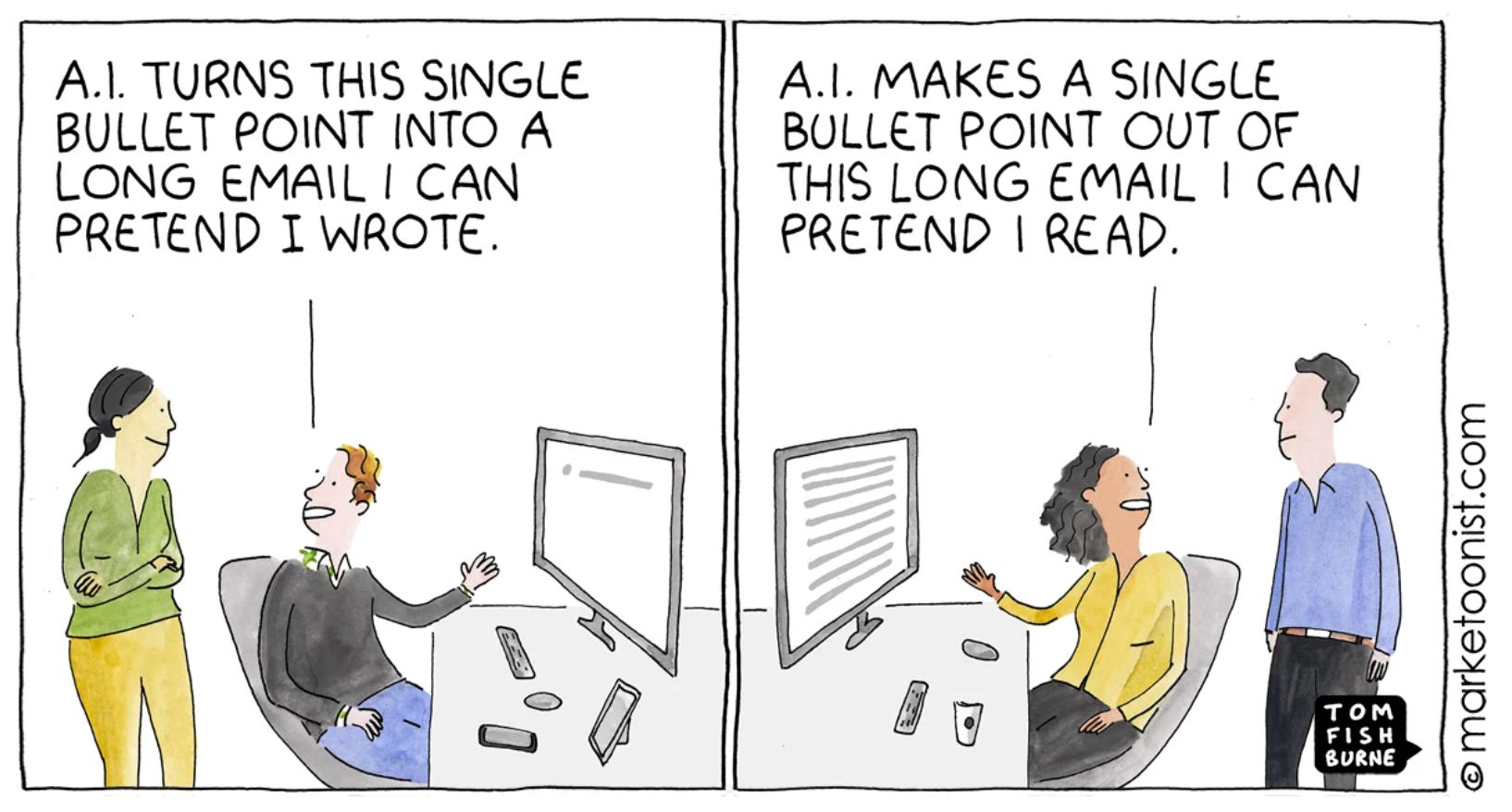
It was named last year by researchers at Stanford’s Social Media Lab and BetterUp, in Harvard Business Review - AI-generated work that looks right, but is often a load of rubbish. The sender looks productive, while the cost of actually doing the work properly moves to whoever has to work out what, if anything, the thing actually says.
In their survey, 41% of US desk workers said they’d been sent some in the past month - and 18% of those using AI at work cheerfully admitted to sending it themselves. The wasted, redone work adds up - for a 10,000-person company they put the bill at around $9 million a year.
And if anything it’s getting worse. A Workday study in January found that for every ten hours AI saves you, nearly four go straight back into checking, fixing and rewriting what it produced.
The reputational cost
Annoying as it is to wade through someone’s slop, the wasted hours aren’t the worst of it - at least from your point of view.
Because what workslop really costs you is your reputation.
The same research found that once someone receives it, they think less of the person who sent it - about half rated them less creative, capable and reliable than before. And nearly one in three said they’d rather not work with them again.
Smith Woodward found that out the hard way. He didn’t forge anything - he just put his name to something he hadn’t checked, and his is the name still attached to the whole embarrassing affair a century on.
Forward something an AI made without checking it, and you’re doing exactly what he did - vouching for it. Pass it on, and you’ve told everyone it’s good - so your name is on it when it turns out it isn’t.
When looking finished costs nothing, polish stops being a signal of anything. The signal that’s left is the opposite one - who actually checked, who read the thing properly and would stand behind it. Which means the person worth working with - teammate, boss, advisor, whoever - is the one who never hands you their mess to clean up.
Piltdown ended up being a handful of bones inflated into an entire human ancestor. Workslop in slow motion - and it lasted forty-one years not because one man forged it, but because everyone after him assumed someone else had checked.
So, before you forward the next report, deck or email an AI made you, ask the only question that still means anything. Would you put your name to it?
Thanks for reading.
Ollie
Ollie on Work is a weekly newsletter about what I’m learning from building with AI, advising leadership teams, and trying to bridge the gap between what technology can do and how businesses actually work. If someone forwarded this to you, you can subscribe here: