

Your company was built for a problem AI just removed
What a 15th-century monk tells us about the shape of the modern company

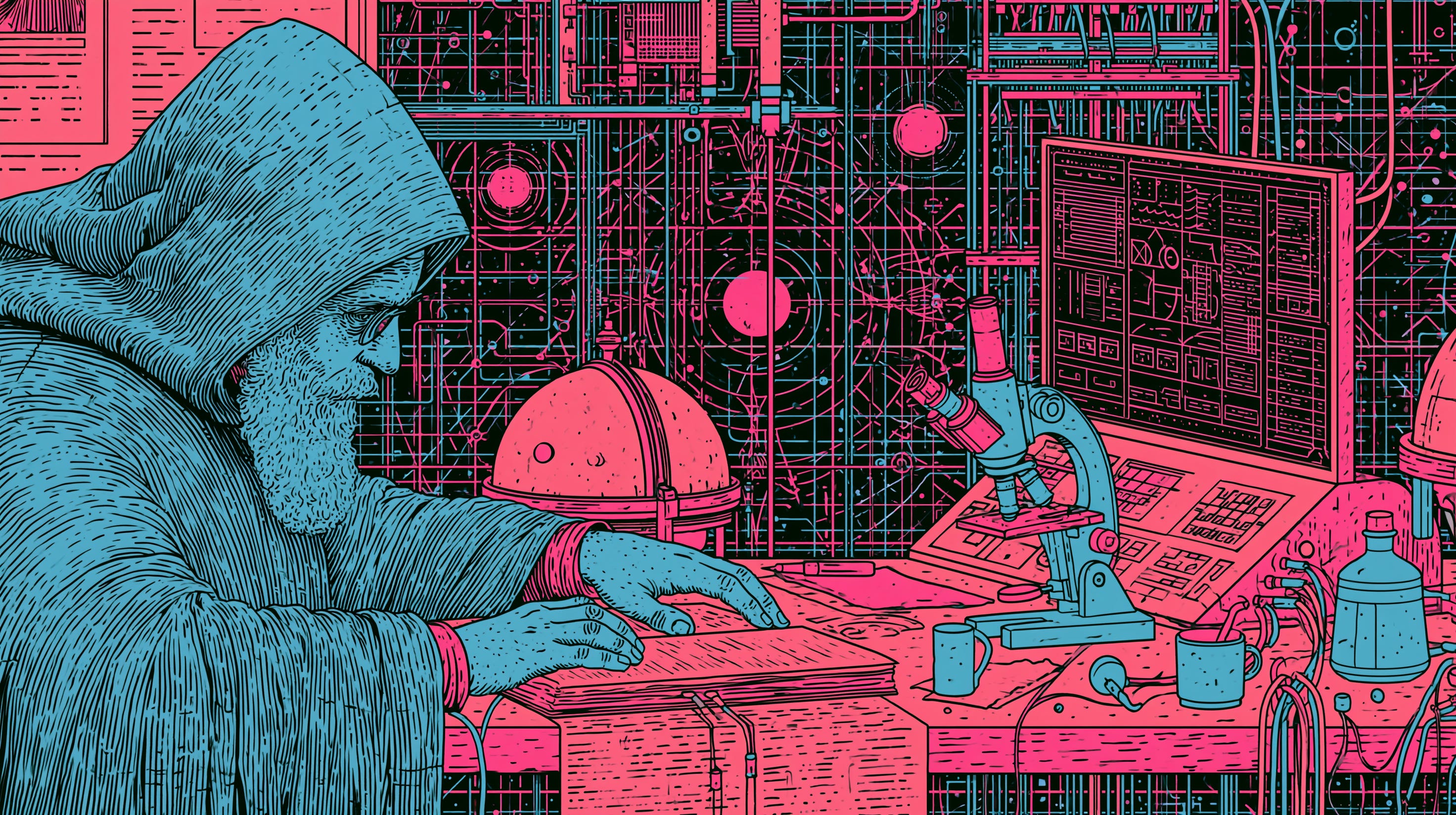
In 1492, the abbot of a monastery in the German Rhineland sat down to defend a craft the printing press was busy making redundant.
His name was Johannes Trithemius, and he ran the Benedictine house at Sponheim. He wrote a long, heartfelt case for monks copying books out by hand - the discipline of it, the devotion, the way a page of parchment might outlast the new printed sheets on their cheap paper.
Two years later, he had it printed.
It’s an easy thing to laugh at, and most people who tell the story stop at the joke. But Trithemius was no enemy of the press. He used it constantly. He had built his abbey’s library from 48 books to more than 2,000, buying printed volumes as fast as he could find them. Numerous editions of his own writing were published in his lifetime. He understood exactly what the machine could do.
But read his case another way, and it isn’t only about handwriting.
For centuries the monastery had been one of the places where knowledge was made, copied and kept. Printing didn’t close the monasteries - they were around long after - but it moved much of that work outside their walls, to printers and booksellers and universities. Trithemius reached happily for the new tool while defending the practices his own institution had been built on.
That’s the part worth carrying five centuries forward.
Smaller and flatter
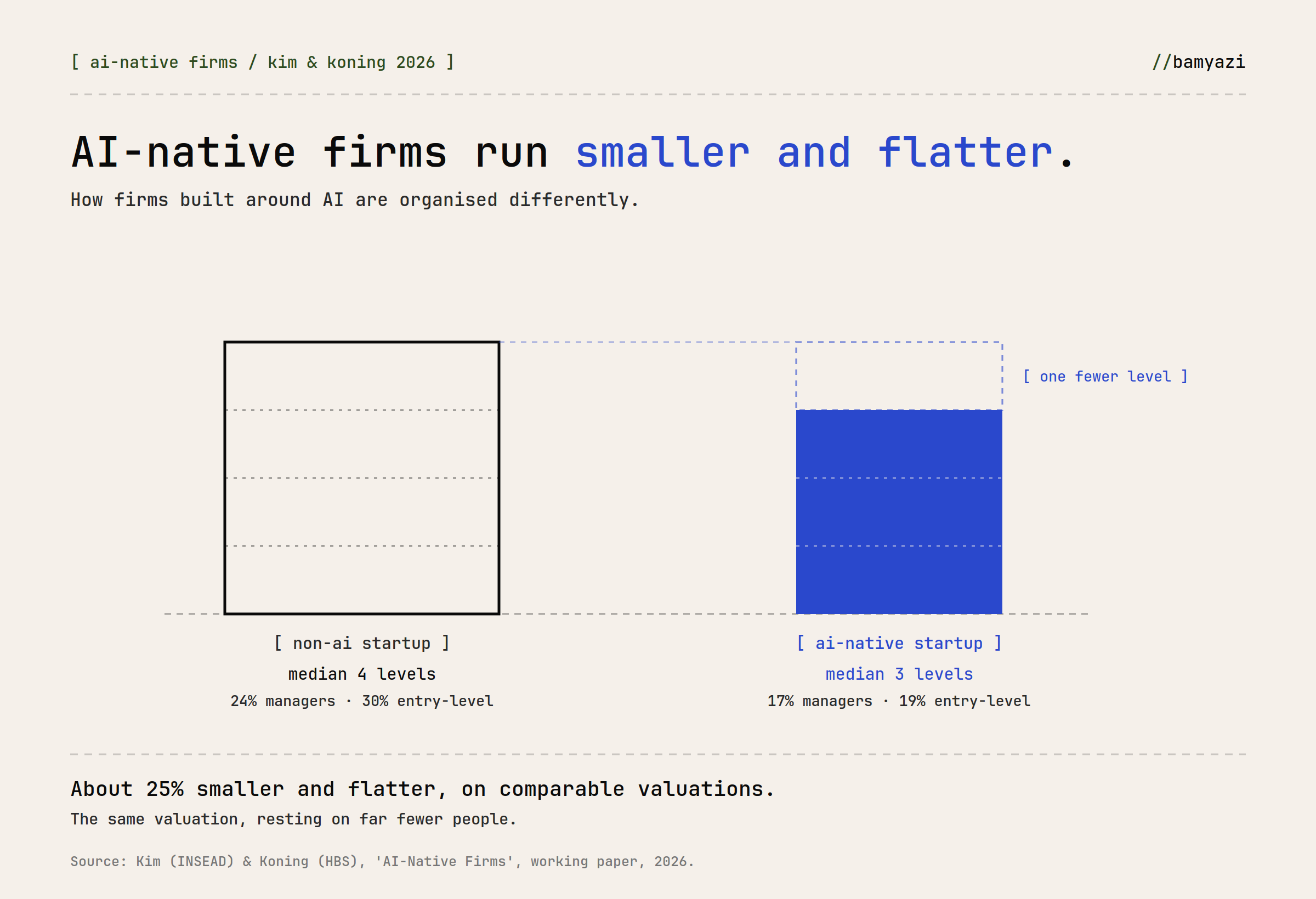
A new paper from Hyunjin Kim at INSEAD and Rembrand Koning at Harvard looked at thousands of startups and found that the ones built around AI are organised differently. They’re about 25% smaller than comparable firms in the same industry, noticeably flatter, with proportionally fewer entry-level workers and managers - and yet they carry much the same valuations.
The usual reading is that AI has made these firms more efficient, which is true to a point. But what if there’s something more significant going on?
The shape of a company is really a response to a problem we’ve half-forgotten - how to move what people know around the place when moving it was expensive. Before the railways and the telegraph, information travelled no faster than a person could carry it, so coordinating a business across a continent was painfully slow. Once that changed, you got the big managerial hierarchy.
The org chart most of us treat as the natural shape of work is, to a large degree, the pipework we built when information was costly to move.
AI changes the maths.
Producing, moving and summarising information is now way cheaper. And when the cost of a thing falls through the floor, the structures we built to manage its scarcity start to look strange.
What the layers were for
Think about what a good chunk of middle management was actually for.
A manager sat above ten people, gathered what each of them was doing, compressed it, and passed it up to someone who did the same again. Remove that cost, and a question you’d once have sent up three layers is now one you can just ask.
I’m going to be careful not to wade into the “middle management is dead” debate - it’s a tired line, and probably wrong. Some of those layers existed mainly to move information up and down, and they’ll go. But others were doing work you don’t notice until it’s gone - bringing on the next lot, or holding a standard nobody wrote down.
The hard part is that you can’t always tell which was which until you’ve already cut it.
Still, there’s a real and hard question here, and most aren’t asking it. I sit in a lot of these conversations, and we almost always assume the company itself stays put. We ask where AI fits into the structure we’ve got. We rarely ask whether that structure was built around a constraint AI has just removed.
Which was Trithemius’s mistake - he embraced the machine and carried on as if his own institution would keep its shape.
So before you ask where AI fits into your organisation, ask the harder question.
How much of what you’ve built only exists because information used to be expensive - and what’s still standing when it isn’t?
Thanks for reading.
Ollie
Ollie on Work is a weekly newsletter about what I’m learning from building with AI, advising leadership teams, and trying to bridge the gap between what technology can do and how businesses actually work. If someone forwarded this to you, you can subscribe here: